

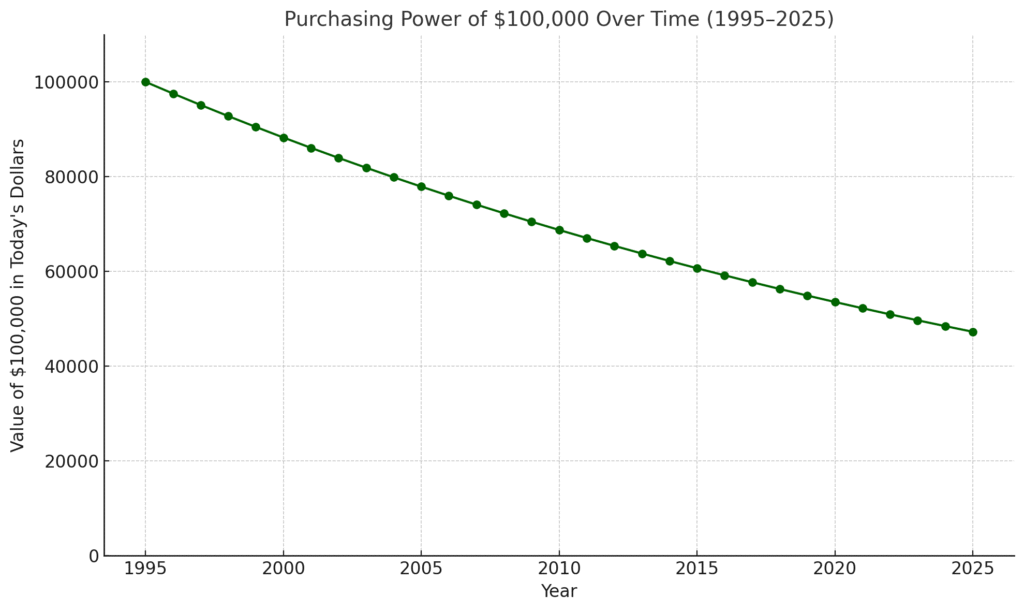
Over the last 30 years, the U.S. dollar has lost 53% of its purchasing power. That means what cost $1 in 1995 now costs $2.13 in 2025. It’s a jarring statistic—quietly shared in a recent post by Peter Mallouk, CEO of Creative Planning—but one that every investor and retiree needs to fully understand.
This isn’t some dramatic economic warning. It’s already happened, with the average annual inflation rate from 1995 to 2025 tabulated at roughly 2.5%
So most people shrug when they hear “2.5% inflation.” It sounds small. Manageable. The truth? Over decades, even modest inflation compounds to drastically reduce the value of your money.
Let’s break it down: – If you held $100,000 in cash from 1995 to today and earned no return, that money now only buys about $47,000 worth of goods and services. – That’s the equivalent of losing $53,000 in silent erosion—with no headlines or breaking news alerts. Now consider this: Many people in retirement, or approaching it, are holding large amounts of cash, CDs, or ultra-short-term bonds out of fear, uncertainty, or just inertia. In doing so, they are slowly but steadily going broke safely.
Why This Matters to Investors of All Ages
Whether you’re 35 or 65, the erosion of purchasing power is one of the greatest long-term financial risks you face. For younger investors, inflation quietly robs your future lifestyle if you’re not investing aggressively enough. For retirees, it’s the stealthy threat that makes your fixed income feel a little tighter every year—even if you’re spending “the same.” And yet, most financial fears today are centered on volatility, not inflation. But the markets recover from bear cycles. Inflation does not reverse.
Doing Nothing Is a Financial Decision
I had recently posted about action bias in investing – where sometimes it’s better to sit tight rather than take action. When markets feel uncertain, sitting in cash or “waiting it out” can feel prudent – and not making a move is, in fact, making a move.
But in this case, it’s a costly one. And not making a move – due to fear, or paralysis – is the worst thing you can do. Time is not your ally when inflation is quietly compounding against you.
Now we’re not talking about your spending cash reserve that covers you for several months. The mistake many people make is treating all cash the same—either holding too much out of fear or investing money they might need soon.
A good financial plan helps you separate the two:
- Keep your reserves safe and accessible.
- Put your long-term dollars to work, so they don’t quietly lose value to inflation.
A good financial plan isn’t about predicting markets. It’s about preparing for the inevitable forces that will impact your money over time—like taxes, inflation, healthcare costs, and longevity.
A good financial plan should help you to:
- Outpace inflation with a portfolio aligned to your goals and time horizon
- Minimize taxes with smart asset location, Roth conversions, or tax-loss harvesting
- Preserve flexibility for rising healthcare and long-term care costs
- Align your spending with your values, so you don’t feel like you’re constantly having to cut back to keep up
So if you’re sitting in cash, or unsure about how your money is positioned, now is the time to revisit your plan. Inflation doesn’t care if you’re nervous. It doesn’t pause while you “wait and see.” It just keeps working—slowly, steadily, and predictably—against your purchasing power. You don’t need to take wild risks to stay ahead of it. But you do need a plan. That’s where working with a fiduciary wealth advisor makes a measurable difference.
Want help reviewing where you stand? I’m here to help you protect what you’ve built—and ensure that your wealth holds its value in the only way that matters: what it can actually do for you over time.