

At its July meeting this week, the Federal Reserve’s Open Market Committee (FOMC) voted to maintain the federal funds rate at its current range of 4.25%-4.5%, a level held since December 2024. This decision comes despite intense pressure from the Trump administration for rate cuts. While the majority of the FOMC voted for the hold, two members, Governors Michelle Bowman and Christopher Waller, dissented, advocating for a quarter-point rate cut at the meeting. This marks a rare occurrence, with multiple governors dissenting for the first time since 1993.
While the Fed held steady, the decision statement and Chairman Powell’s remarks suggest a potential opening for a rate cut later in the year, particularly if economic growth further moderates and the labor market shows more weakness (which it did this morning – see below). Clearly the bias is shifting toward easing, sooner than later. Inflation readings remain slightly softer than expected, which supports the case for eventual cuts. The Fed continues to emphasize a “data-dependent” approach, meaning future policy decisions will hinge on incoming economic information and the evolving outlook; they have also often used the Jackson Hole Symposium in August as a time to discuss big policy pivots, and this August could be a useful time to signal this shift lower in rates.
Inflation remains “somewhat elevated” and above the Fed’s 2% target, with the core Personal Consumption Expenditures (PCE) index (the Fed’s preferred inflation gauge) rising 2.8% annually in June.
Concerns over employment were heightened this morning as a jobs report sent a bit of a shockwave through the markets. 73,000 jobs were added last month – a number lower than expected. But the real kicker was the revision of the previous two months, as employers added a combined 258,000 fewer jobs in May and June than initially reported.
Despite this recent data, the U.S. economy is still proving resilient despite global tensions and trade barriers. The news of a 15% EU deal is very encouraging, and there were few other restrictions in the preliminary agreement. But investors should prepare for some economic drag as these tariffs take hold in the second half of the year. The cumulative inflation impact from tariffs is likely to be modest, perhaps 1.5% to 2% over two years, while the GDP drag remains limited and manageable.
The market has come to terms with this dynamic and continues to look ahead to more powerful, longer-term forces, particularly the ongoing AI. I think the market rightly assesses this will buoy productivity and earnings. In particular, the immediate expensing provision for capital equipment that came in the ‘One Big Beautiful Bill’ is a meaningful tailwind for corporate investment, counteracting some negative tariff effects.
U.S. equity markets continue trending higher, overcoming a challenged stretch earlier in the year when the benchmark S&P 500 dropped nearly 20% in value in a matter of weeks. After hitting its 2025 low point on April 7, the S&P 500 has gained more than 28% in value. In recent weeks, the S&P 500 repeatedly topped all-time highs.
Our investment strategy remains consistent. On the equity side, we remain well-diversified across market capitalizations and geographies, with a tilt toward U.S. large-cap exposure, focusing on quality and dividend-growing companies. On the international side, we also continue to thoughtfully split our exposure between both developed and emerging markets. Developed holdings like Japan, the U.K., and Europe offer stability and diversification, while emerging markets such as India, Taiwan, and Brazil provide long-term growth potential.
On the fixed income side, we continue to balance high-quality core holdings (like AGG) with income-enhancing allocations (including HYG and EMB). Overall, we remain diversified across government, muni, corporate, floating rate, mortgage-backed securities, and emerging markets.
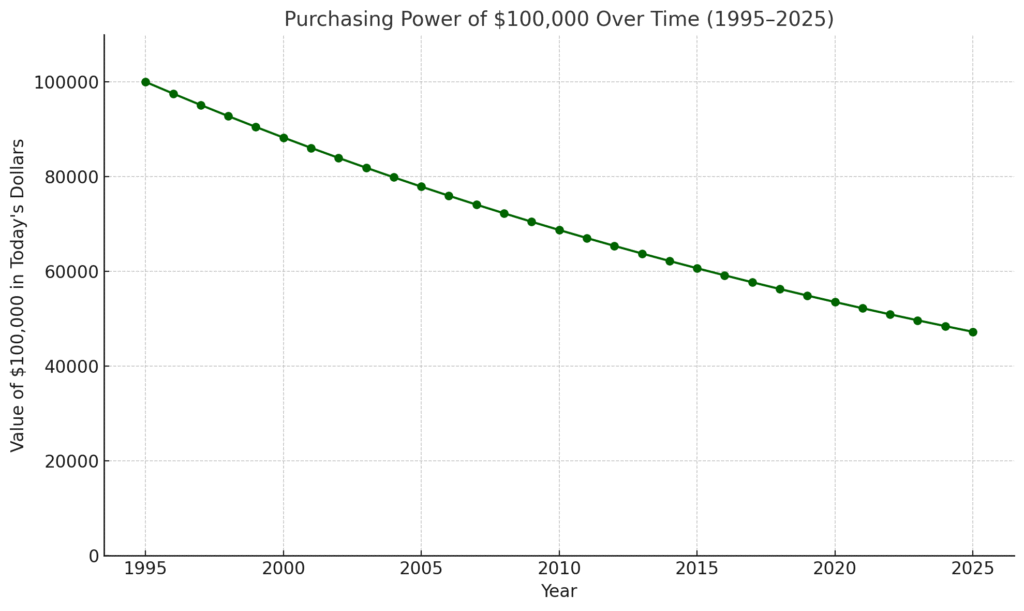
Purchasing Power of the Dollar
Peter Mallouk is a nationally recognized financial advisor, bestselling author, and Forbes’ former #1 independent wealth advisor. He is the CEO of Creative Planning Group.
Recently, Mallouk published an article highlighting the fact that the U.S. dollar has lost 53% of its purchasing power over the last 30 years. From 1995 to 2025, U.S. Consumer Price Index (CPI) data shows that $1 in 1995 now buys only about $0.47 worth of goods and services – meaning that $1 in 1995 buys what takes $2.13 today. The average annual inflation rate from 1995 to 2025 was approximately 2.5%
So sure, deferring investment decisions or hoarding cash may feel ‘safe,’ but over decades it’s guaranteed to shrink your buying power. A thoughtful investment strategy isn’t just about returns—it’s about preserving and growing real purchasing power. That’s where financial planning makes the difference.
For Further Reading
Fed holds interest rates steady: What that means for car loans, credit cards, mortgages and more
The High Cost of Doing Nothing: Why Inflation Is the Most Predictable Threat to Your Wealth
Pick up the Pace: A Small Change Could Bring Big Health Benefits
Wishing you and your family a fun end of summer!
– Bill