

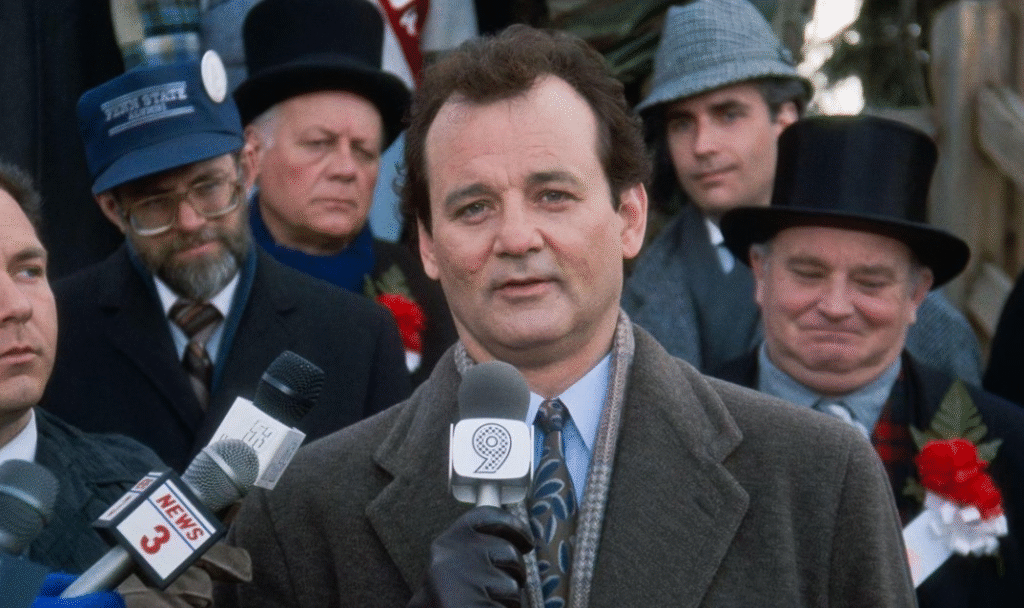
February arrives with a familiar feeling – much like Groundhog Day. Investors are watching the same themes resurface: inflation that refuses to fully retreat, interest rates paused but not yet falling, and markets reacting quickly to headlines while waiting for clarity that never quite arrives. Like the movie, it can feel repetitive, but the lesson is the same each time: reacting to short-term noise rarely changes the long-term outcome. What matters more is recognizing the cycle, staying disciplined, and positioning portfolios to endure uncertainty rather than trying to predict exactly when conditions will finally shift.
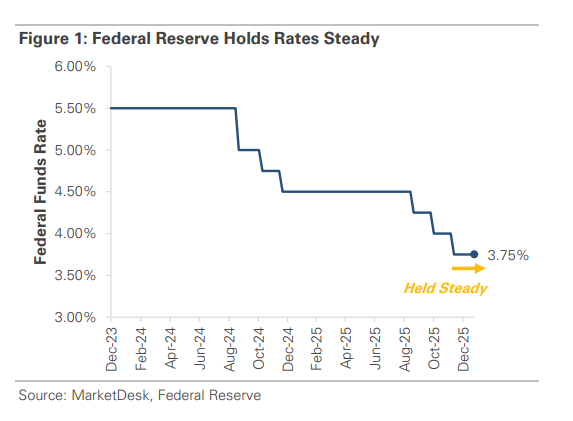
As widely expected, the Federal Open Market Committee paused rate cuts at its January meeting, keeping the federal funds target range at 3.50%–3.75%. This followed a cumulative 75-basis-point reduction across the final three meetings of 2025. The obvious question now is whether this is merely a pause that allows policymakers to assess incoming data, or the early signal of a transition to the next phase of the rate cycle (the Fed’s version of “let’s wait and see”).
At the same time, Donald Trump has nominated a new Chair of the Federal Reserve amid resilient economic growth and persistent inflation pressures. The announcement sparked immediate reactions across financial markets, including a sharp surge in gold and silver prices. Investors initially interpreted the decision as a potential shift in monetary policy, reviving concerns around inflation, fiscal deficits, and long-term confidence in the U.S. dollar. Precious metals rallied quickly as capital flowed toward perceived safe havens, with silver showing especially extreme price moves. Notably, the rally occurred without clear confirmation from inflation data, real interest rates, or bond markets.
As expectations around policy leadership stabilized, prices reversed just as quickly, reinforcing how difficult it is to time moves in precious metals. Gold and silver tend to act as long-term hedges against uncertainty rather than reliable short-term trading vehicles, and their prices are often driven by sentiment around headlines rather than fundamentals. The episode serves as a reminder that these assets are best viewed as diversifiers within a broader portfolio, not tactical bets, particularly during periods of heightened political and policy uncertainty tied to the Federal Reserve.
Key Economic Indicators
- GDP Growth: The U.S. economy posted strong 4.4% annualized growth in Q3 2025; growth is expected to moderate to 2–3% in 2026.
- Inflation (CPI): Consumer inflation remains above the Federal Reserve’s 2% target, running around 3.4%, reflecting lingering price pressures.
- Federal Funds Rate: The Federal Reserve held interest rates steady at 3.50%–3.75%, balancing inflation risks against a cooling labor market.
- Unemployment Rate: The unemployment rate stands near 4.4%, still historically low but trending higher.
- Job Growth: Payroll growth has slowed meaningfully compared to prior years, pointing to a softening labor market.
- Yield Curve: The yield curve shows interest rates on short-term versus long-term U.S. Treasury bonds. Right now, rates across different maturities are unusually close together, which typically happens late in an economic cycle. This reflects slower growth expectations and uncertainty around future Federal Reserve policy.
The U.S. economy appears to be slowing but not stalling, with growth moderating, inflation proving sticky, and labor markets gradually cooling. This environment reinforces the importance of diversification: equity returns may become more dependent on earnings quality, while bonds and income-oriented strategies regain relevance as interest rates stabilize and the prospect of future rate cuts comes back into view.
Things change. Diversification is key.
Case in point: U.S. vs international returns move in cycles: there are multi year windows where international equity outperforms and windows where the U.S. equity (the S&P 500) outperforms, and 2025 was a clear example of international leadership. For the full year, the S&P 500 (iShares Core S&P 500 ETF – IVV) returned approximately 17.9 percent, while MSCI World ex USA delivered roughly 29 percent, a material gap in favor of non-US equities.
Vericrest portfolios captured that leadership through our international holdings including iShares Core MSCI EAFE ETF (IEFA), iShares Core MSCI Emerging Markets ETF (IEMG), and WisdomTree Dynamic International Equity Fund (DWM), which provided exposure to both developed and emerging markets outside the United States. The takeaway is not that international equities always outperform, but that leadership rotates, often sharply and unexpectedly. By holding international equities alongside U.S. stocks, we reduce reliance on a single market, participate when global leadership shifts, and improve long term risk adjusted outcomes across full market cycles.
This chart below reinforces that point by showing rolling five-year total returns comparing U.S. equity (the S&P 500) to international equity (the MSCI World ex-USA). The blue areas represent periods when U.S. stocks outperformed international stocks, while the red areas show extended stretches when international markets led.
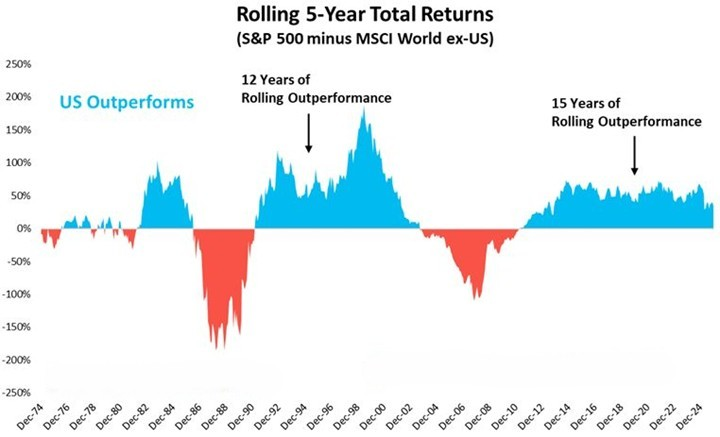
What stands out is not just that leadership rotates, but how long those cycles can last. There have been multi year periods where one market dominated returns for a decade or more before leadership reversed. This is exactly why diversification matters:
- Investors who abandon international exposure after long periods of U.S. outperformance risk missing the next cycle when leadership shifts.
- A globally diversified portfolio is designed to endure these rotations rather than trying to time them, keeping investors positioned for whatever market leads next.
- History suggests that leadership rarely moves in straight lines or on predictable schedules. Rather than making a binary bet on which market wins next, our approach is to remain globally diversified so portfolios are positioned to participate regardless of where returns emerge, reducing the risk of being wrong at exactly the wrong time.
This rotation is not limited to U.S. versus international markets. It also occurs within the U.S. equity market itself.
The U.S. equity market is comprised of:
- Large-cap stocks are well-established companies with market values typically above $10 billion and tend to be more stable.
- Mid-cap stocks ($2–$10 billion) often balance growth potential with moderate risk.
- Small-cap stocks, generally under $2 billion in market value, can offer higher growth opportunities but usually come with greater volatility.
After extended stretches of large-cap dominance, leadership can shift quickly and unexpectedly. This is why our portfolios include specific mid-cap and small-cap ETF holdings, alongside large-cap exposure. The chart below highlights periods where small-cap stocks outperform large-cap stocks, followed by reversals as market conditions change. Diversifying across market capitalizations increases the likelihood of participating when leadership rotates, rather than relying on a single segment of the market to carry returns.
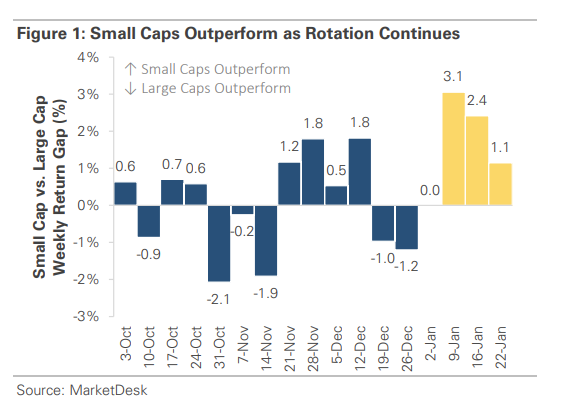
In plain English: no one knows in advance which part of the market will lead next. By owning large, mid, and small-cap stocks together, portfolios are positioned to benefit when leadership shifts instead of having to guess when that shift will happen.
Further Reading
Market headlines change weekly. Long-term plans don’t need to. It’s easy to feel pressure to react as markets respond to news, forecasts, and short-term noise, but history suggests a different path to success. The investors who tend to reach their goals aren’t the ones who perfectly time entries and exits – they’re the ones who stay invested, rebalance regularly, and let time do the heavy lifting.
For those interested in the data behind this investment and financial planning approach, the articles below highlight why market timing is so difficult, how missing just a few strong days can materially impact returns, and why discipline and consistency tend to outperform prediction over time.
- Vanguard — Why staying invested matters
https://advisors.vanguard.com/insights/article/staying-the-course-does-not-mean-set-it-and-forget-it
- Fidelity — The cost of missing the market’s best days
https://www.fidelity.com/learning-center/wealth-management-insights/3-reasons-to-stay-invested
- Investopedia — Why market timing consistently falls short
https://www.investopedia.com/new-data-affirms-old-rule-do-not-try-to-time-markets-7569835
- Burton Malkiel — A Random Walk Down Wall Street (overview)
https://en.wikipedia.org/wiki/A_Random_Walk_Down_Wall_Street
Thanks,
Bill