

The February economic data delivered exactly what markets needed — not perfection, just confirmation.
Inflation continues to cool, and the labor market remains intact. CPI came in softer than expected, with rental components finally reflecting the long-awaited deceleration in housing costs. Real weekly earnings are up roughly 1.9% year over year — the strongest improvement since the pandemic — meaning purchasing power is actually rising. Hourly real earnings are growing closer to 1.2%, but that near-2% gain in weekly pay tells us something important: consumers are not getting squeezed the way headlines suggest. At the same time, unemployment ticked lower, broader U-6 measures improved, and jobless claims continue to hover in the 200,000–240,000 range — a level consistent with resilience, not overheating. That is a constructive backdrop for risk assets.
GDP growth has moderated from last year’s pace but remains positive. The economy is slowing — not collapsing. That distinction matters. Money supply growth has stabilized, inflation is trending toward the Federal Reserve’s 2% objective, and employment has not deteriorated. That combination gives the Fed room to gradually ease policy without looking like it is responding to crisis. Interest rates remain elevated relative to the last decade, but bonds are once again paying investors real income. For years the question was “why own bonds?” Today the math answers itself.
Housing remains a structural supply issue, not a demand implosion. Rents are stabilizing — which is helping CPI — yet home prices are not meaningfully falling because regulatory and zoning constraints continue to limit supply. We have seen dramatic productivity gains in nearly every sector over the past 50 years. Homebuilding is not one of them. Still, stabilizing shelter costs are directly supportive of disinflation and real income growth, reinforcing the broader macro backdrop.
There are, of course, crosscurrents. AI-driven disruption fears are rippling through markets at extraordinary speed. Entire industries are being repriced on the possibility of disintermediation. That creates volatility. But historically, technological revolutions expand productivity and real incomes over time. The anxiety is concentrated in select AI-linked leaders and industries perceived as vulnerable. Meanwhile, large portions of the non–Magnificent 7 market trade at reasonable valuations and may ultimately benefit from AI adoption rather than be harmed by it. Productivity gains do not accrue solely to technology providers — they lift margins across industrials, healthcare, financials, and consumer sectors. That’s where valuation support sits today.
Volatility remains elevated, with the VIX hovering near 20. That tells us hedging activity is active. Interestingly, sustained VIX readings above 20 have historically coincided with sufficient pessimism to provide support under equities. Excessive complacency — a VIX at 14 or 15 — would concern me far more. Short-term churning, including sharp moves in speculative assets like Bitcoin, is noise inside a functioning market.
Year to date, U.S. large caps continue to lead, with performance concentrated in earnings-resilient businesses. Small caps remain rate-sensitive and more uneven. International markets are positive but trailing. Fixed income is modestly positive, driven by income rather than price appreciation. That combination — stable growth, cooling inflation, resilient employment, and functional credit markets — is not the backdrop that historically ends bull markets. It is typically the environment in which they broaden.
Advances Are Permanent. Declines Are Temporary.
Shelby Cullom Davis once said, “Advances are permanent, declines are temporary.” Davis (no relation) built his philosophy around long-term economic progress and the upward bias of productive economies. The data support his point. From June 1949 through June 2025, the average bull market lasted 5.3 years with gains of +254%. The average bear market lasted 1.0 year with a decline of -31%. Even the painful downturns of 2000–2002 (-47%) and 2007–2009 (-55%) were followed by extended advances of +841% and +527%, respectively. Declines tend to be sharper. Advances last longer. Compounding does the heavy lifting.
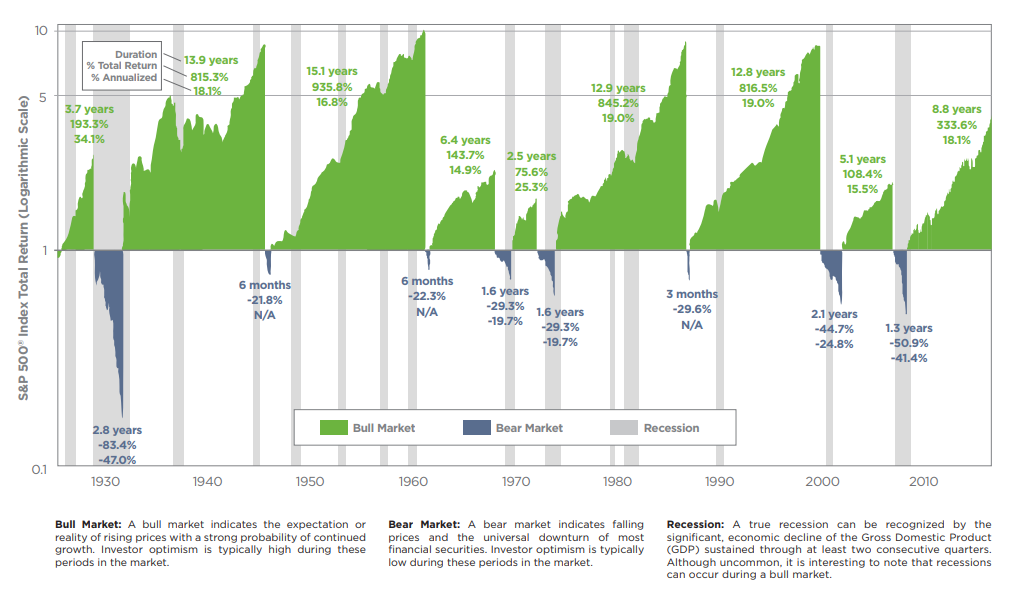
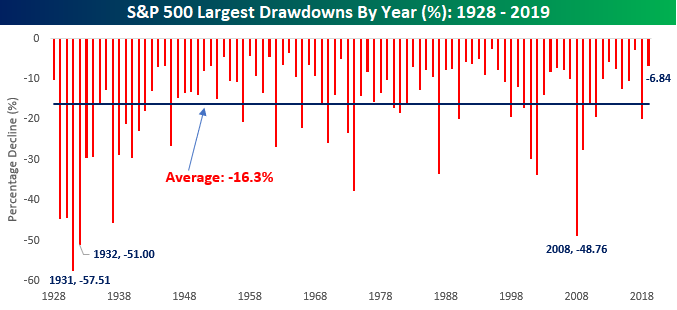
This is precisely why our portfolios are positioned the way they are: core U.S. large-cap exposure for earnings durability, a disciplined growth tilt for long-term productivity expansion, meaningful international diversification for cycle rotation, and short-to-intermediate duration fixed income for income and stability. We are not allocating based on headlines or reacting to daily volatility. We are structuring portfolios to move through full economic cycles — expansions, slowdowns, policy shifts, technological revolutions — because those cycles are permanent features of markets.
Technological change will disrupt industries. Some business models will be impaired. But productivity growth is deflationary and wealth-enhancing over time. If we eventually see shorter workweeks because output per hour rises, that is not a recession signal — that is a prosperity signal.
The data right now tell a clear story: inflation is receding, real incomes are rising, employment is stable, GDP is positive, and policy has room to adjust. That is not an environment that historically derails bull markets. It is an environment that allows them to mature and broaden.
Volatility will remain. It always does.
Progress tends to remain longer.
Further Reading
As always, here are a few articles that we’ve recently published that may be of interest.
What to Do With Unused 529 Plan Assets: A Decision Framework for High-Net-Worth Families