

This past month may have answered a few questions—but it raised plenty more.
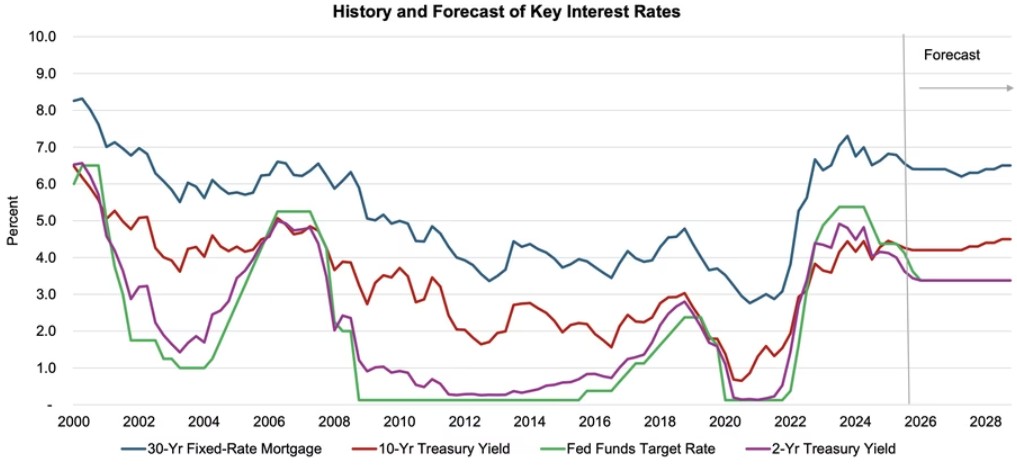
The Federal Reserve delivered its second consecutive interest rate cut, lowering the benchmark rate by another quarter point to a range of 3.75%–4%. Chair Jerome Powell joined the 10–2 majority on the Federal Open Market Committee (FOMC), but offered no clear guidance for the next decision in December.
Complicating matters, several key federal economic reports remain delayed due to the ongoing government shutdown. While September’s Consumer Price Index (CPI) was released before the disruption, other vital data—including the jobs report, job openings, and the Personal Consumption Expenditures (PCE) index (the Fed’s preferred inflation measure)—have been postponed. Policymakers are effectively making decisions with partial visibility, adding an unusual layer of uncertainty to the months ahead.
Markets took the rate cut in stride. Equities were largely unchanged, while bond prices fell, signaling that investors may see fewer cuts ahead than the Fed’s tone implies.
Meanwhile, mortgage rates had already moved lower in anticipation of this meeting, reaching their lowest level in over a year—6.19%, according to Freddie Mac. However, the Mortgage Bankers Association (MBA) expects 30-year rates to remain elevated—between 6% and 6.5% through 2028—even as housing supply gradually improves. As the MBA recently noted:
“While mortgage rates are not expected to decline further, housing supply has increased in recent months, which will ease home-price growth and provide more housing options for prospective buyers.”
The group also projects a national home-price decline for several quarters before returning to modest growth by late 2027.
For context, the national median family income is now $104,200 (HUD), and the median existing home price in August was $422,600 (NAR). Based on a 20% down payment and a 6.26% mortgage rate, the resulting monthly payment—about $2,080—represents roughly 24% of a typical family’s income.
Markets and Earnings
Earnings remain the market’s engine—and they’re still running strong. Corporate guidance has been steady or improving, even as tariff-related costs are absorbed. AI capital spending and M&A activity remain robust, while leadership is beginning to broaden beyond mega-cap tech.
Autos posted standout results, and early signs of renewed value participation have emerged. I’m not ready to call a lasting rotation from growth to value, but the foundation looks healthier than it did six months ago.
Volatility has eased from recent highs, yet sentiment remains cautious—this is no “melt-up” environment. With earnings leadership intact and positioning still conservative, the S&P 500 appears capable of pressing toward (and possibly through) the 7,000 level as the Fed’s policy pivot unfolds and profits compound.
With ongoing uncertainty around the Fed’s path, short-term yields may ease as longer-duration assets begin to regain relative strength. At the same time, U.S. equities have pushed to new all-time highs, supported by resilient earnings and moderating inflation.
The “K-Shaped” Economy — Or Something More Nuanced?
The phrase “K-shaped recovery” was first coined by market strategist Peter Atwater in 2020 and quickly gained traction among economists and Fed officials. It described an uneven post-pandemic rebound—where parts of the economy (the top arm of the “K”) surged upward while others (the lower arm) lagged behind.
In this framework, affluent consumers benefit from market gains, home-price appreciation, and strong job prospects, while lower- and middle-income households face rising living costs, tighter credit, and slower wage growth.
That narrative has resurfaced again this year, but I’m not entirely convinced it captures the full picture. The U.S. economy today is far more complex than a simple split between “haves” and “have-nots.”
Beneath the surface are dozens of sub-sectors and regional variations—different industries, business models, and household balance sheets moving in their own directions. Technology, travel, housing, and healthcare each tell their own story. Even within income brackets, spending patterns and financial resilience vary widely.
In short, the U.S. economy looks less like a clean “K” and more like a dynamic mosaic—uneven, yes, but still adaptive and evolving.