

I hope you and your families had a nice Labor Day! (In case you’re interested, here is an article from the Department of Labor on the history of the holiday.)
The story this month is the Fed and if their September meeting will end in an interest rate change.
The Federal Reserve’s primary inflation rate, the core PCE price index, matched expectations for July in the first big data test for Federal Reserve policy since Chairman Jerome Powell signaled a resumption of rate cuts is likely at the Sept. 17 meeting.
Chair Powell’s speech at the annual Jackson Hole Economic Policy Symposium marked a long-awaited pivot—and markets rejoiced. The dovish tone was stronger than expected, with the Fed signaling it is prepared to “look through” tariff-driven inflation. That shift puts us clearly on a path toward easing, barring any major surprises—a positive for equities, housing, and rate-sensitive sectors.
Powell downplayed tariff-induced price increases, calling them one-time and exogenous. This matters: if the Fed is no longer chasing inflation caused by non-monetary forces, the focus shifts to the labor market, where signs of slowing are mounting.
The market now expects steady 25-basis-point cuts at each meeting through year-end, putting the fed funds rate near 3% by early 2026. With prepayment risk elevated and spreads wide, 30-year mortgage rates could fall a full percentage point even without large moves in long-dated yields.
These cuts matter. Roughly $20 trillion in loans are tied directly to the fed funds rate – through SOFR (Secured Overnight Financing Rate), LIBOR (the London Interbank Offered Rate), and prime-linked loans – including credit cards and small business debt. A 75–100 basis-point reduction delivers real relief.
So, what does all this mean for investors? Equities are in a strong position, especially considering the rally during a seasonally typically weak period. Markets are brushing that off and pressing toward new highs. The “beat rate” in Q2 (the percentage of companies that successfully surpass analysts’ expectations) was among the best we’ve seen in years, and Q3 guidance looks strong. And the wealth effect from rising equities and crypto is supporting high-end consumer demand, and while lower-income consumers may start to feel the bite of tariffs, we haven’t seen a meaningful pullback in spending yet. Unless we see a sharp labor market decline or a major geopolitical shock, we believe this rally continues.
Our portfolios remain broadly diversified, with U.S. large, mid, and small-cap equities complemented by international developed and emerging markets. We balance high quality growth exposure with core bonds – ultimately designed to capture long-term growth while managing risk across different market environments.
If the Fed begins cutting rates in September, the effect should be broadly positive for our portfolios. Equities—especially U.S. growth stocks—tend to benefit as lower borrowing costs boost earnings and valuations, while core bonds gain from falling yields. Mortgage-backed securities and high-yield bonds also stand to improve, though floating-rate holdings give up some yield. Overall, rate cuts would be a tailwind for both stocks and bonds, positioning the portfolio well.
The Federal Funds Rate
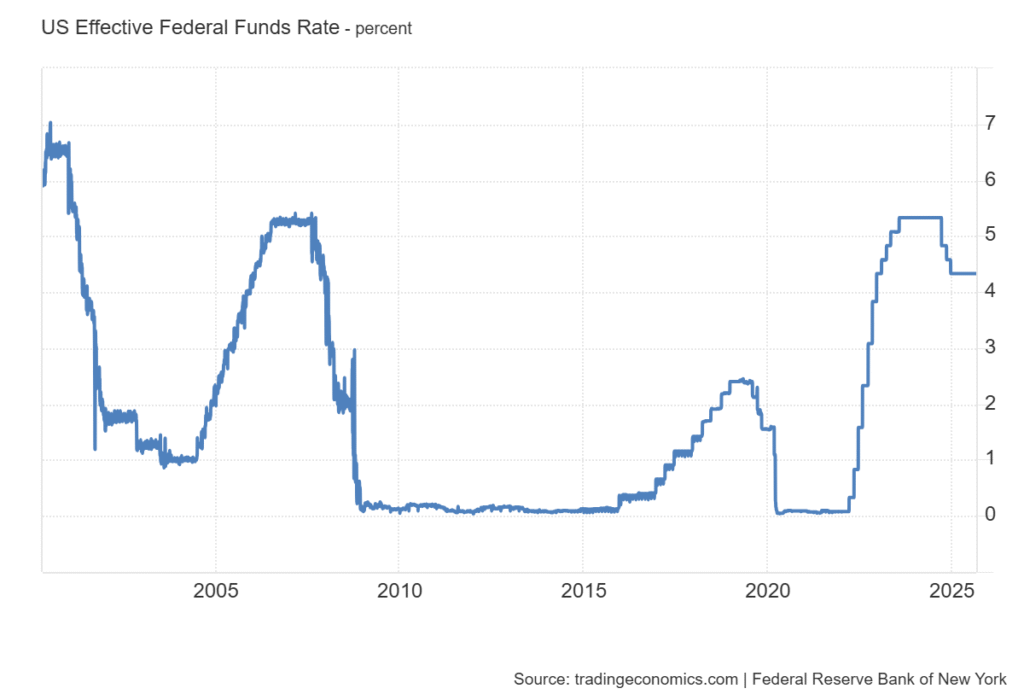
The target range for the federal funds rate is currently 4.25% to 4.50%, with the Effective Federal Funds Rate (EFFR) currently at approximately 4.33%. The EFFR represents the median rate banks charge each other for overnight loans and is a key indicator of the actual market rate.
Below is Effective Federal Funds Rate from 2000 through August 2025. Effective Federal Funds Rate in the United States averaged 4.60 percent from 1954 until 2025, reaching an all-time high of 22.36 percent in July of 1981 and a record low of 0.04 percent in December of 2011.
The Calendar Effect
You might think that October is the worst month for stocks, given that history’s major market crashes always seem to happen in that month. Believe it or not, September is actually the weakest month of the year for stock performance. The Dow Jones Industrial Average, the S&P 500 and the Nasdaq composite all offer their worst average return during this period, according to Dow Jones data.
On average, the Dow suffers a 1.1% decline, the S&P 500 falls 1.1% and the Nasdaq composite drops 0.9%. Small cap investors have bragging rights, as it is only the second-worst average return of any month for the Russell 2000, with an average decline of 0.6%.
Does that mean investors are in for a rocky ride next month?
It has been a roller-coaster year so far for the stock market, but major indexes are all holding solid gains heading into September. In September 2024, the S&P 500 rose 2%, the Nasdaq gained 2.7% and the Dow Jones index climbed 1.9%. The Russell 2000 notched a slimmer lift of 0.6%.
While historical data may show September as a weaker month for stocks, this calendar-based strategy is flawed and generally ineffective for building long-term wealth. Ultimately, we know that the possibility of stock market volatility in any month should not impact the plans of any long-term investors. And if you need a refresher on why “time in the market” proves better than “timing the market,” go here: Time in the Market (and not Timing the Market)
Tech Valuations: Bubble Fears vs. Fundamentals
The “bubble” debate around big tech and the Magnificent 7 continues in 2025. To ground that conversation, it helps to revisit history. During the dot-com bubble, forward P/E ratios for the tech sector peaked near 55x earnings, often without actual earnings to support them. Prices floated on speculation. (See chart below.)
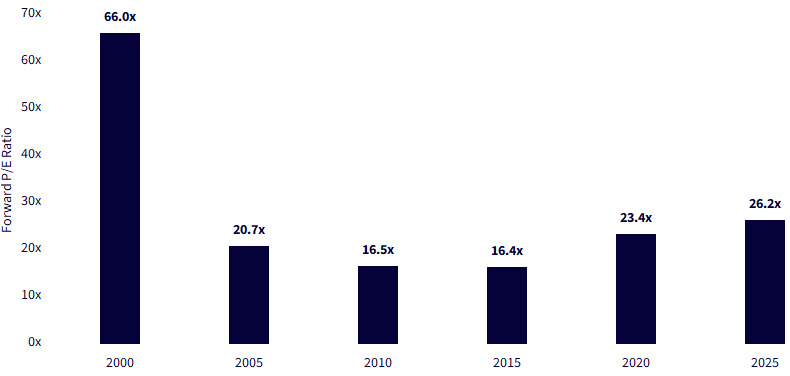
Today looks different. As of August 19, the S&P 500 Technology Sector Index trades at 29.7x forward earnings—above its historical median of 22x, but far from dot-com extremes. More importantly, valuations rest on massive revenue, proven business models, and enormous free cash flow. Earnings power is visible in quarterly reports, not hypothetical.
History – from tulip mania to dot-com – shows how narratives can outrun reality. This time, however, the fundamentals back the story. Today’s tech leaders are generating real profits and durable growth. The data suggests we’re not in a bubble, but in a fundamentally supported expansion.
If you’d like more in-depth view of this, please take a look at this article:
Additional Reading
Here are a few articles that I’ve recently published or came across that are worth reading:
- What High-Income Earners Need to Know about the “One Big Beautiful Bill” and 2025 Tax Planning
- There’s a ‘golden opportunity’ to pay 0% capital gains under Trump’s ‘big beautiful bill,’ experts say
- Trump’s new tax law expands 529 savings plan uses as families gear up for back to school
- How Can an Economy This Good Feel This Bad?
As always, if you have any questions about how these developments may affect your portfolio or broader financial plan, please don’t hesitate to reach out—I’m here to help. Wishing you and your family a smooth transition into the new season, and an enjoyable start to fall.
Bill