
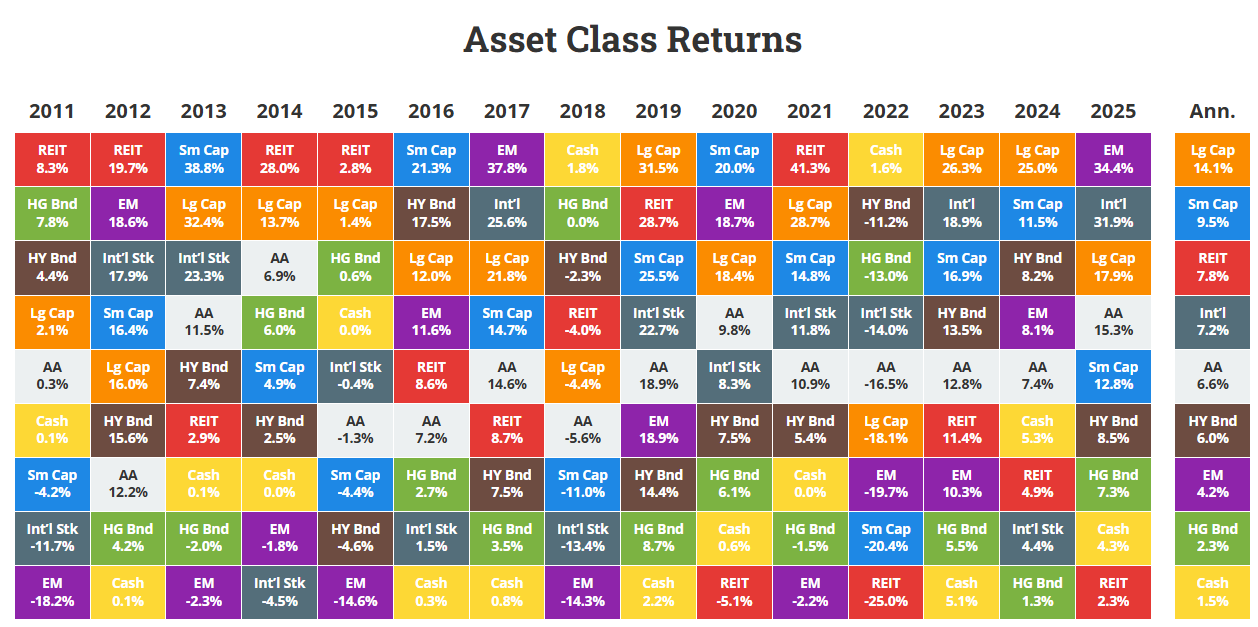
There are very few investment visuals that tell the truth as clearly as this one.
The annual asset class performance chart shows how different parts of the market perform relative to one another each year. Rows represent calendar years. Columns represent major asset classes—U.S. stocks, international stocks, emerging markets, real estate, bonds, commodities, and cash. The best-performing asset class for a given year appears at the top; the worst falls to the bottom.
When viewed across many years, one thing becomes immediately clear: leadership is constantly changing.
The 2025 asset class performance chart reinforces this reality once again. Asset classes that were strong performers in recent years moved lower in the rankings, while others quietly took the lead. No single category dominates consistently. There is no reliable pattern to chase. And there is no shortcut to knowing in advance which asset will outperform next year.
This is precisely why diversification matters.
Diversification is not designed to maximize returns in any single year. Its purpose is to manage uncertainty over time. By spreading investments across asset classes that respond differently to economic growth, inflation, interest rates, and market stress, investors reduce their dependence on being “right” about the future.
The chart highlights the danger of concentration. When investors pile into what has worked most recently, they are often doing so just as leadership is about to rotate. The data shows repeated examples of top performers falling toward the middle—or even the bottom—the following year. Chasing performance can feel rational in the moment, but history shows it is rarely rewarded over full market cycles.
Another important takeaway is that diversification works across cycles, not short windows. It can lag during periods when one asset class dominates, which is often when its value is questioned the most. But those periods tend to be followed by sharp reversals, and the chart documents those reversals clearly.
The 2025 data is a useful reminder after a stretch of markets where diversification appeared unnecessary to some investors. Extended runs in a single asset class can distort expectations. This chart brings perspective back into focus by showing how quickly leadership can change—and how unforgiving markets can be to portfolios that are overly concentrated.
For long-term investors, this chart is not about predictions. It is about discipline. It provides a visual framework for understanding why portfolios are constructed intentionally, rather than based on headlines or recent returns. It reinforces the idea that a sound investment strategy is built to endure a range of outcomes, not just the most popular one.
That is why this chart matters. It doesn’t promise higher returns in every year. What it offers instead is something far more valuable: perspective, humility, and a reminder that diversification remains one of the most reliable tools investors have.